Machine Learning Tutorials
A five-part path from the training loop to physics-informed neural networks. Every tutorial is a runnable notebook with visual explainers. The goal isn't just to run code, but to understand what the model is actually doing.
I wrote these while assisting Dr Sathiskumar Ponnusami at Queen Mary University of London.
-
Machine Learning Training from Scratch: Loss, Gradients, and Overfitting
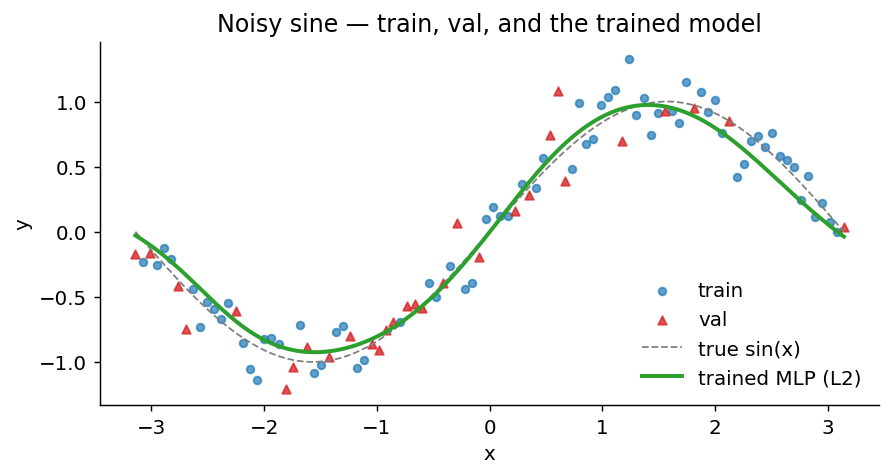
Hand-derive the gradient, write the training loop in NumPy, then again in PyTorch. Watch a deliberately oversized model overfit, then fix it three ways.
Reproduce the classic train-loss-down, validation-loss-up overfitting curve and learn what fixes it.
-
scikit-learn Regression Tutorial: Explore, Fit, Evaluate, Diagnose
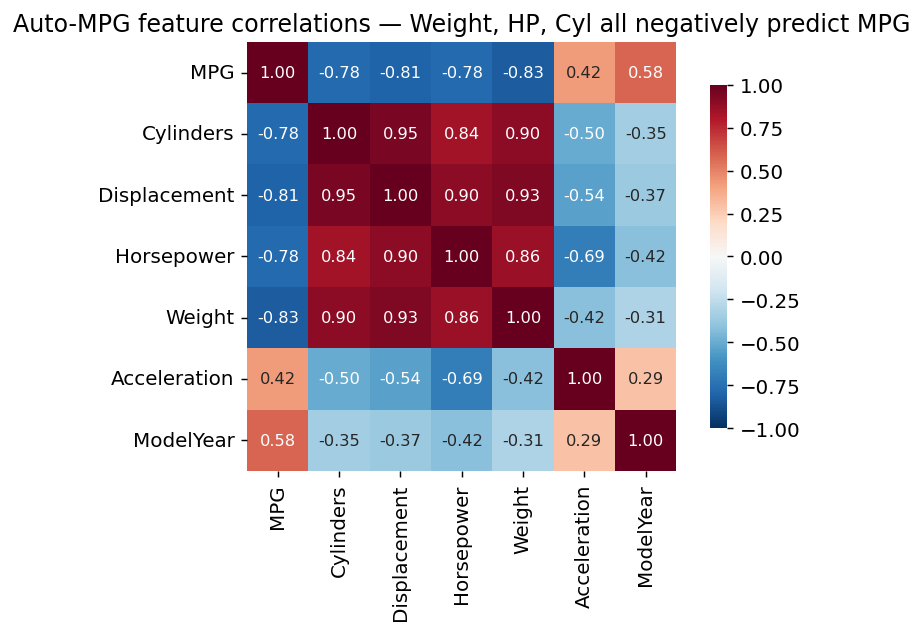
A complete tabular-ML workflow on the UCI auto-MPG dataset: load, explore, split, fit, evaluate, diagnose. Single-feature first, then multi-feature.
Build the full tabular ML loop and see why a pretty regression line is not enough.
-
Neural Networks from One Neuron to a PyTorch MLP Classifier
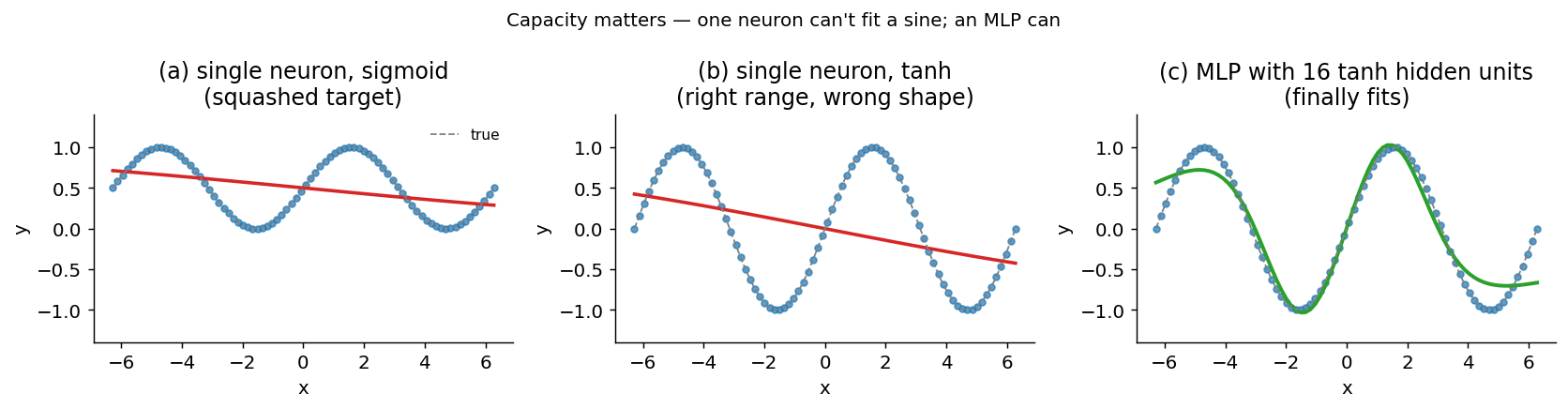
One neuron to matrix layer to PyTorch abstraction to an MLP that fits a sine wave, then a real binary classifier on Wisconsin breast cancer data.
See exactly when one neuron fails, why a hidden layer works, and how the same pattern becomes a classifier.
-
Convolutional Neural Networks from Pixels to Feature Maps
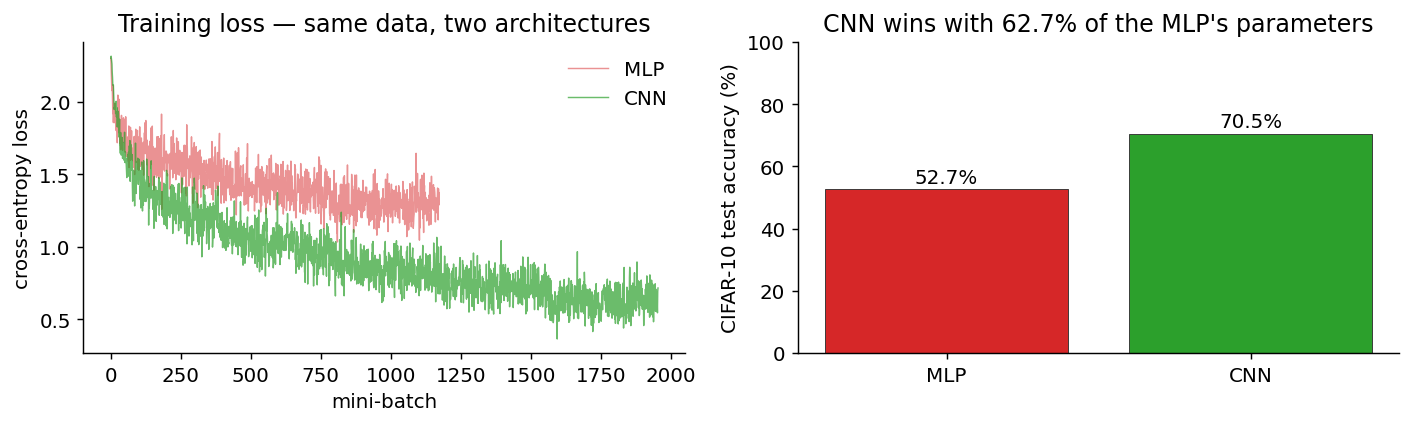
Why MLPs fail on images, what a convolution actually does, and how to read what a trained CNN has learned.
Train a small CNN, compare it with an MLP, then open the model and inspect the filters.
-
PINN Tutorial in PyTorch: Damped Oscillator, Autograd, and Inverse Problems
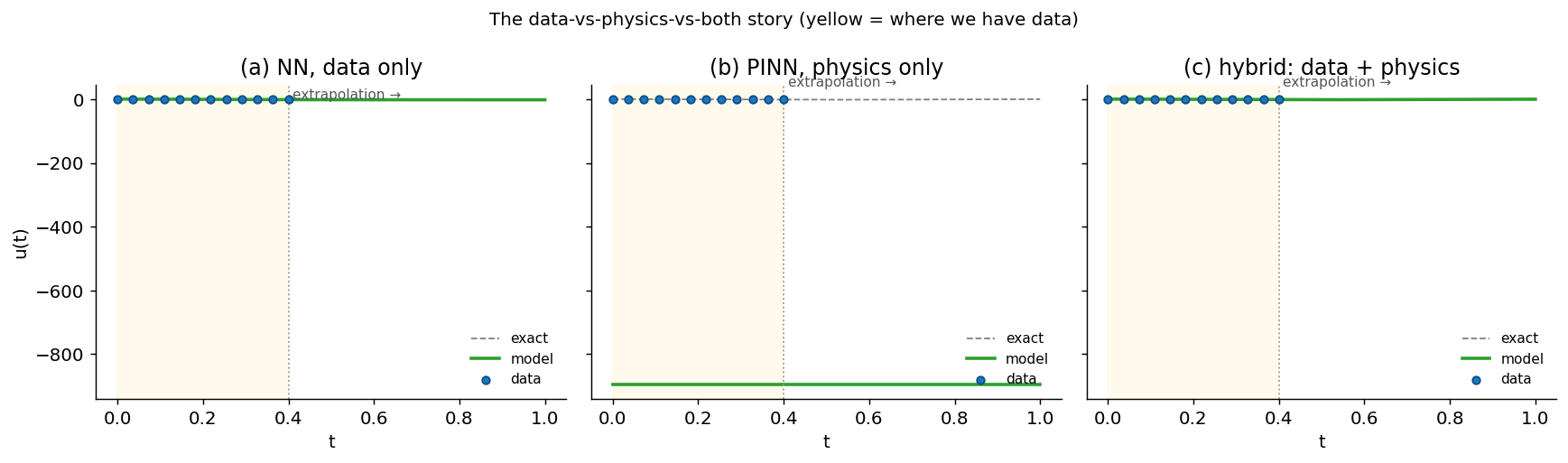
Data, physics, or both? A damped oscillator compares all three on the same architecture, then bridges to inverse problems and neural operators.
Use torch.autograd.grad to make a neural network obey an ODE, then turn the same idea into an inverse problem.