The mistake in beginner scikit-learn is not usually the .fit() call.
It is trusting the first number that looks good. A model can draw a nice
line and still fail systematically on the held-out data.
The day-to-day API is tiny: instantiate a model, call .fit, call
.predict. Everything else is choosing which model, which features,
and which numbers to trust when evaluating it.
from sklearn.metrics import root_mean_squared_error, r2_score

model = LinearRegression()
model.fit(X_train, y_train)
pred = model.predict(X_test)
rmse = root_mean_squared_error(y_test, pred)
r2 = r2_score(y_test, pred)
This tutorial walks the entire workflow on the UCI auto-MPG dataset — 392 cars from the 1970s and 80s — and ends with the diagnostics that turn a fit into an honest answer. We start with a single feature (Weight → MPG), then add Horsepower and Cylinders, and watch the metrics improve.
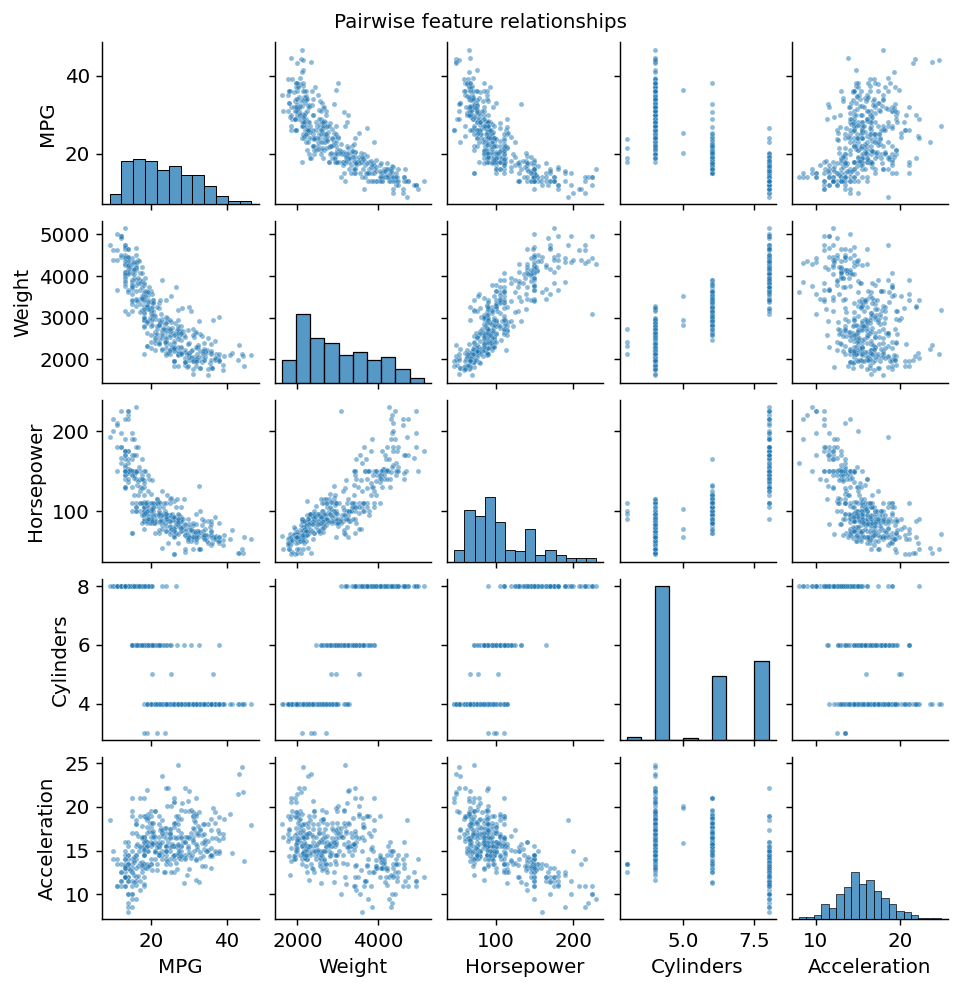
Pairwise relationships
The single-feature fit
Three lines and you have a linear regressor: LinearRegression(),
.fit(X, y), .predict(X_test). The pattern is the same for every
model in sklearn.
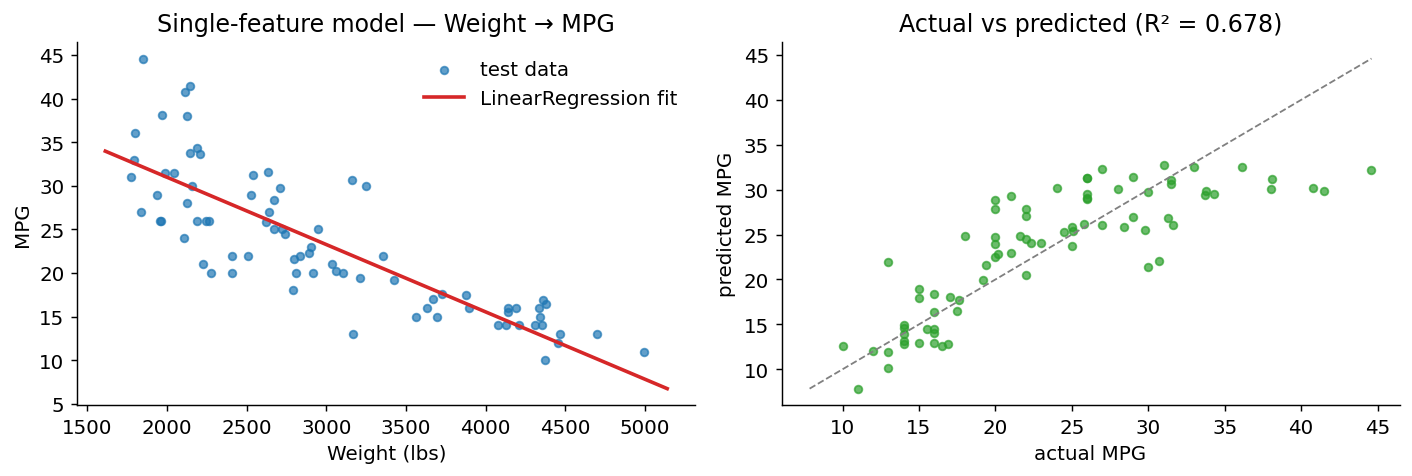
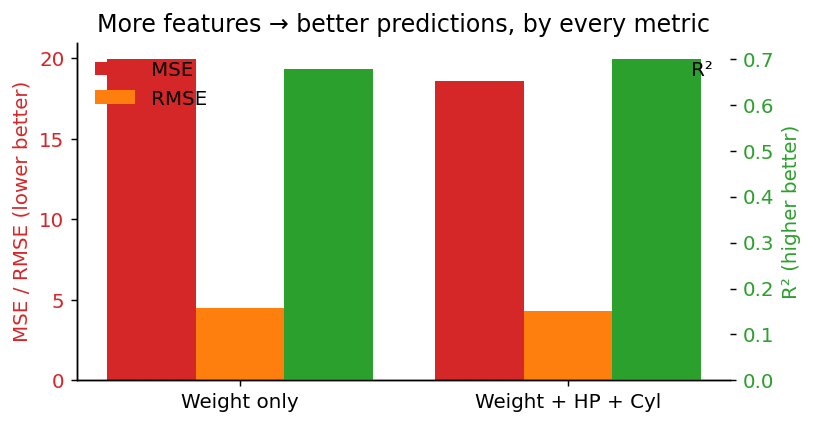
Weight alone explains 67.8 % of the variance in MPG (R² = 0.678, RMSE = 4.47). Already decent for one column.
Adding more features
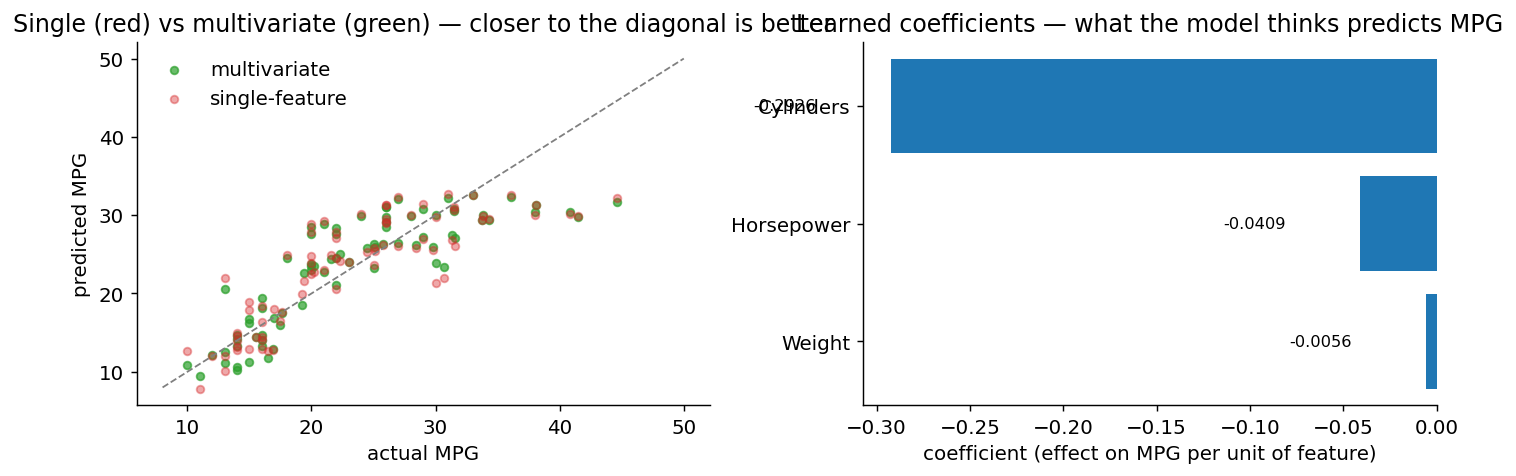
Same workflow, more columns in X. Going to Weight + Horsepower +
Cylinders improves R² to 0.701 (RMSE 4.31). Modest gain because
Weight is already capturing most of the predictable variance — Horsepower
and Cylinders are heavily correlated with it.
The bias-variance trade-off
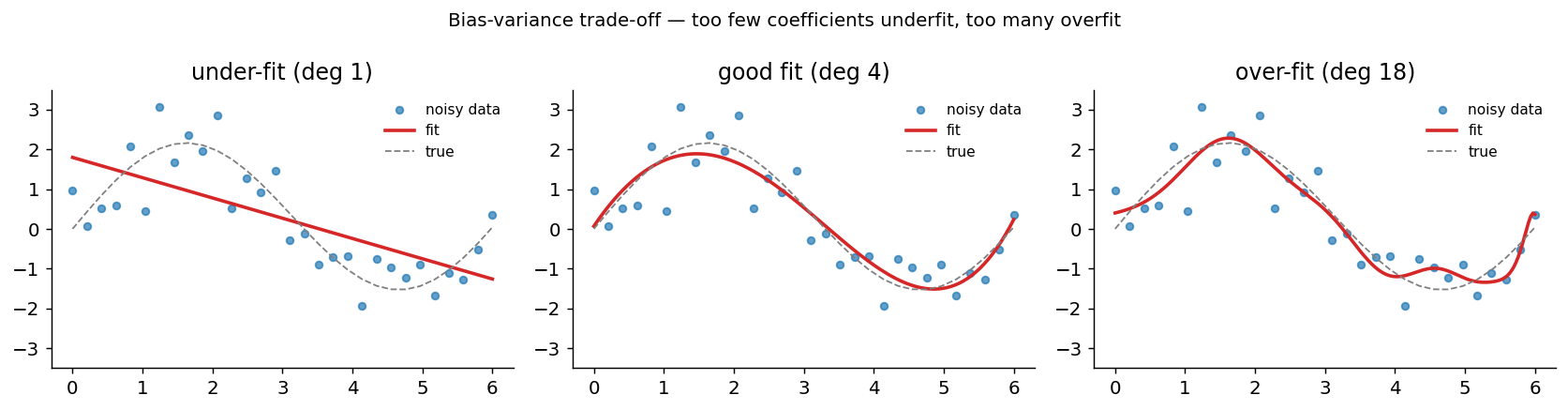
A linear model with one feature cannot capture curvature — it underfits. A polynomial regression with too many terms memorises the noise — it overfits. The right answer lies between. Every ML problem has some version of this picture; it is the most important intuition to internalise early.
What’s in here
- The full
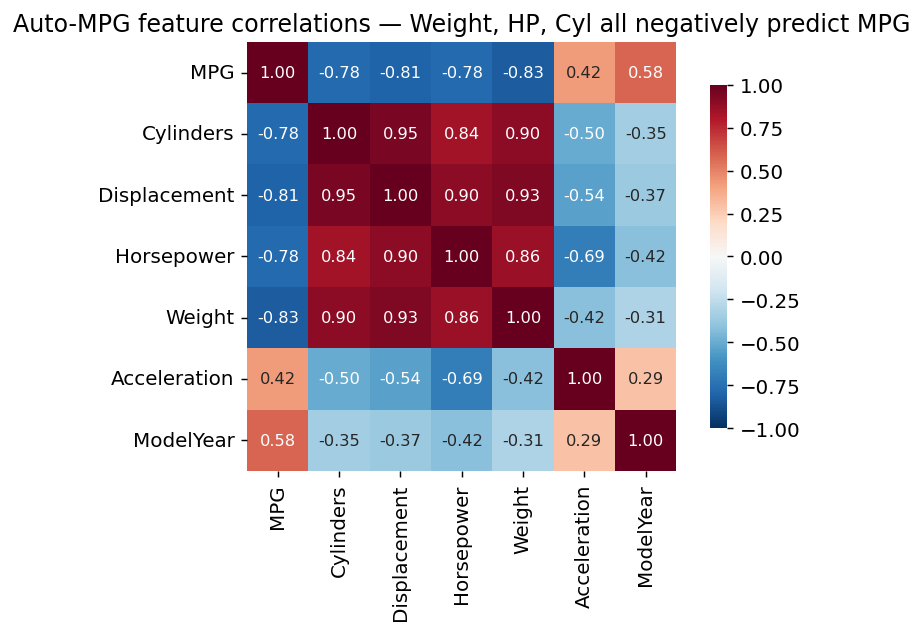
load → explore → split → fit → predict → evaluateworkflow - Correlation heatmap + pairplot as your two first plots, always
LinearRegression,train_test_split, MSE / RMSE / R²- Single-feature vs multi-feature regression on the same data
- Reading coefficients carefully when features are collinear
- The bias-variance trade-off, drawn as one figure
- Four open-ended exercises at the end
Prerequisites
- Comfortable with pandas DataFrames
- Knowing what a
forloop is
Next
03 — Introduction to Neural Networks— what changes when the model is a network and the framework is PyTorch.
References
- Pedregosa et al. (2011). Scikit-learn. JMLR 12. JMLR
- Quinlan, J. R. (1993). Combining instance-based and model-based learning. ICML 1993 — the auto-MPG dataset, originally from the StatLib archive. PDF
- James, Witten, Hastie & Tibshirani (2021). An Introduction to Statistical Learning, 2nd ed. — chapters 3 (regression) and 5 (resampling). statlearning.com