The confusing part of neural networks is not the word “neural”; it is the jump from one weighted sum to a system that can learn curved decision boundaries. This tutorial keeps that jump small.
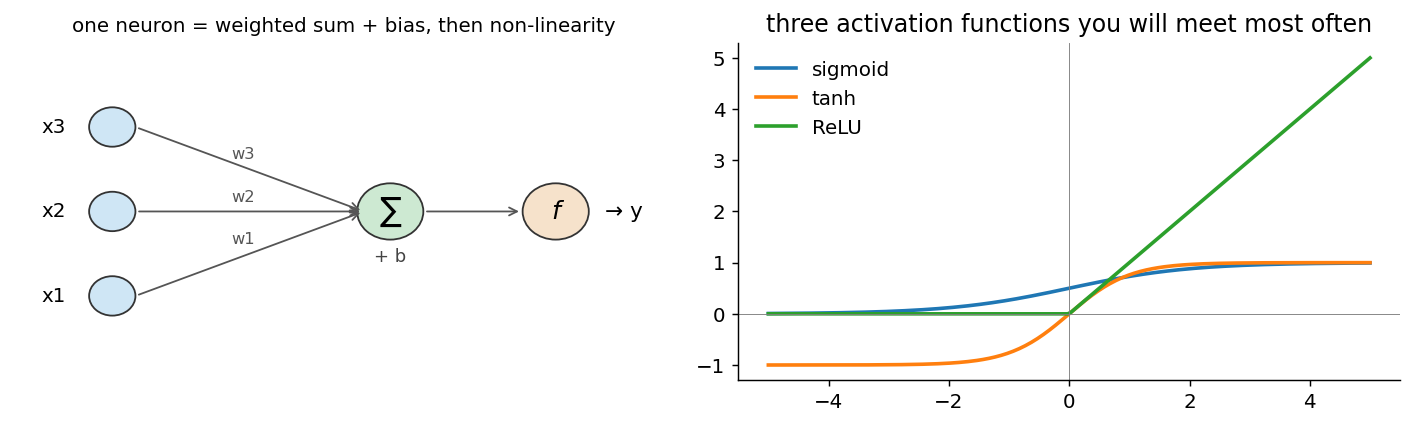
A neural network is what you get when you stack a lot of \(f(w \cdot x + b)\) neurons and let gradient descent set the weights. We build that stack one layer at a time, then use the same pattern for a classifier on the Wisconsin breast-cancer dataset (569 patients, 30 features).
model = nn.Sequential(
    nn.Linear(30, 32),
    nn.ReLU(),
    nn.Dropout(0.2),
    nn.Linear(32, 1)
)
loss = nn.BCEWithLogitsLoss()(model(x), y)
From neuron to layer: the matrix form
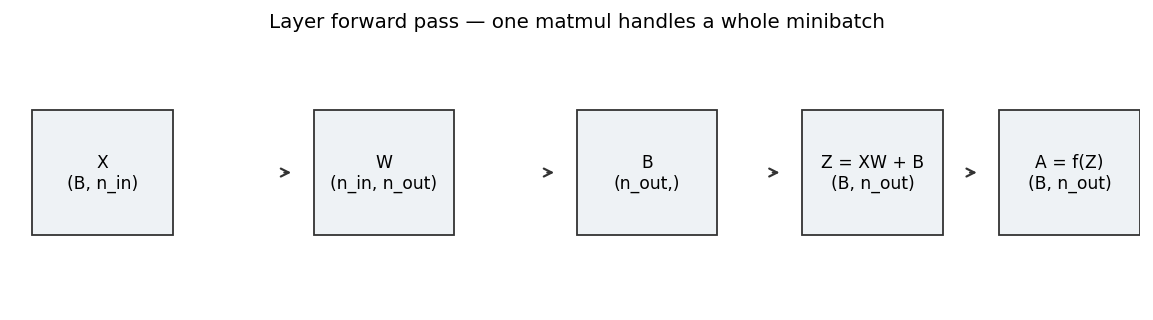
A layer is many neurons applied to the same input in parallel. Instead of computing one weighted sum at a time, a single matrix multiplication handles the whole minibatch:
\[\mathbf{Z} = \mathbf{X}\,\mathbf{W} + \mathbf{B}, \qquad \mathbf{A} = f(\mathbf{Z}).\]- \(\mathbf{X}\) is the input data.
- \(\mathbf{W}\) is the weight matrix.
- \(\mathbf{B}\) is the bias vector.
- \(f\) is the non-linear activation function.
The activation function is what makes a stack of layers nonlinear. Without it, several linear layers collapse into one linear map, so depth alone would not add representational power.
Capacity matters — what one neuron cannot do
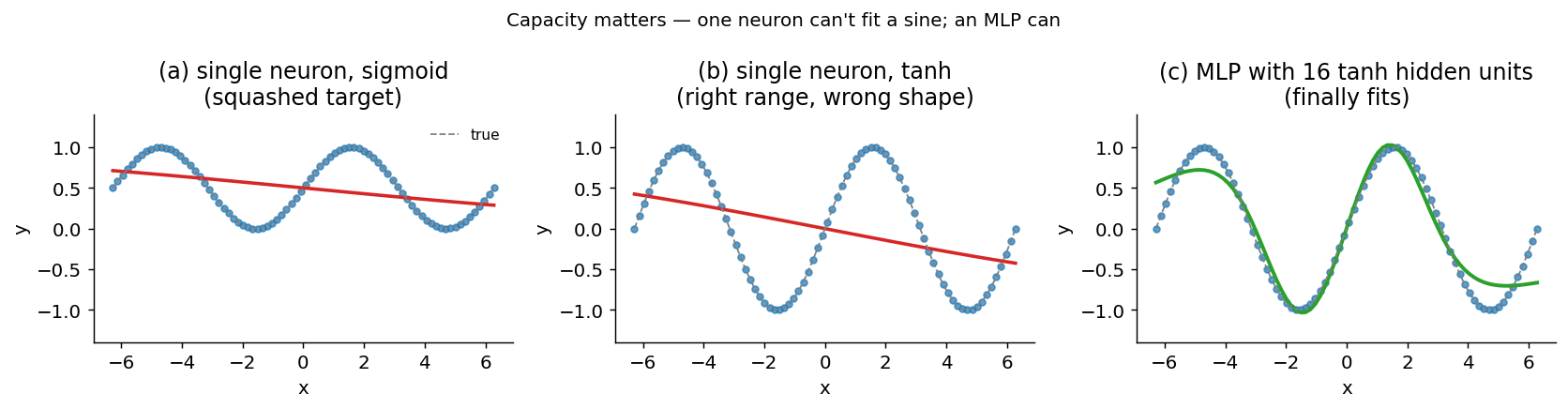
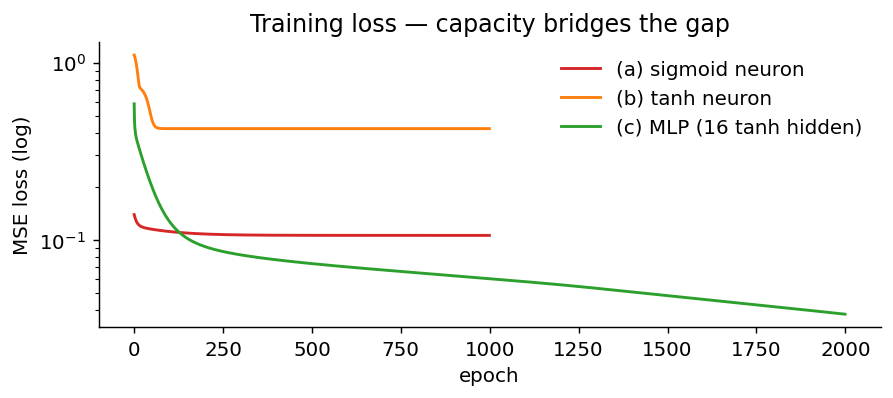
The cleanest demonstration of why we need multiple neurons is to try fitting a sine wave with one.
A single tanh neuron can choose the right output range, but its shape is
still a smooth S-curve. It cannot follow a periodic function that turns up,
down, and up again over the interval.
A hidden layer changes the situation. A multilayer perceptron (MLP) with
one hidden layer of 16 tanh units can combine several shifted S-curves, so
it fits the oscillation much more closely.
Apply it — Wisconsin breast cancer
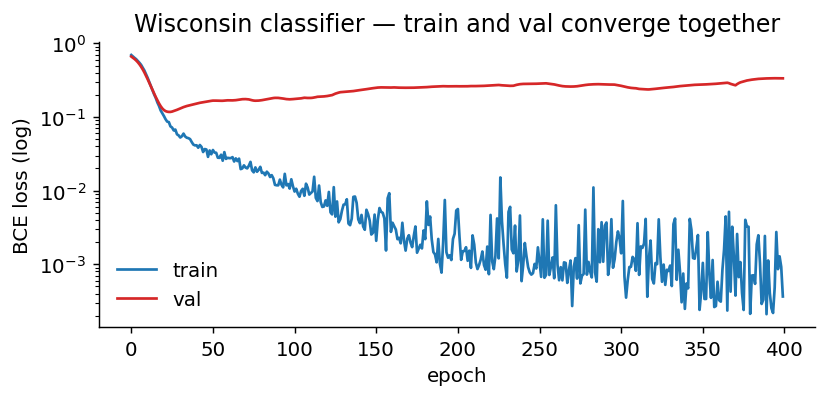
Now the MLP machinery becomes a real medical classifier. 30 numerical features (radius, texture, perimeter, area, smoothness…) per patient, binary malignant / benign label. The architecture is the same 2-hidden-layer template with dropout; the loss switches from MSE to binary cross-entropy.
Why accuracy alone is dishonest
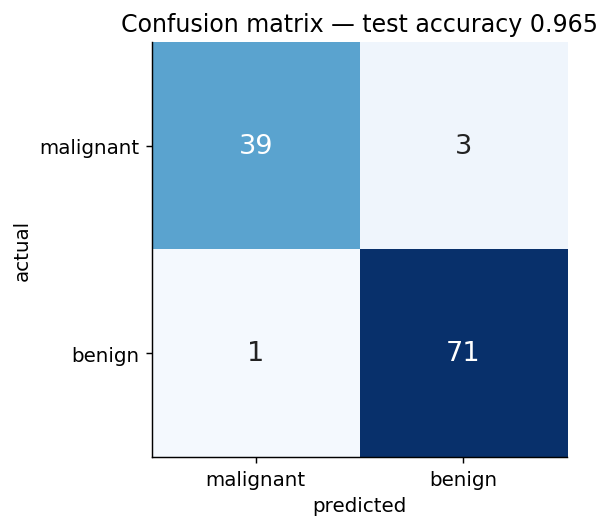
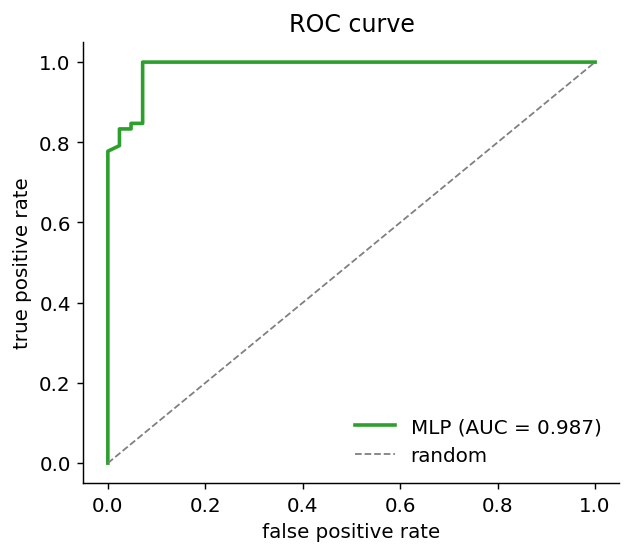
A 95 %-accurate classifier that misses every cancer is worse than useless. You always want the confusion matrix (where the errors fall) and the ROC (how the trade-off between false-positives and missed-positives behaves as you sweep the decision threshold).
What’s in here
- The single neuron (
f(w · x + b)), three activation choices - Matrix formulation of a layer — one matmul per minibatch
- A manual gradient-descent training loop with autograd
- The same model rewritten in
nn.Module— verbose to terse - Activation matters — sigmoid vs tanh on a sine wave
- Adding a hidden layer — when one neuron isn’t enough
- Real-data application: Wisconsin breast-cancer classification
BCEWithLogitsLossand why it beatsBCE + sigmoidas two ops- Confusion matrix + ROC + AUC
Note on data ethics
The Wisconsin dataset is real but anonymised, 1995-era, and a teaching standard. Production medical-ML projects need IRB approval, calibration plots, and uncertainty quantification well beyond a confusion matrix. This tutorial is for the model and metrics, not for clinical deployment.
Prerequisites
- Tutorial 01 — the training loop
- Tutorial 02 — train/test splits
Next
04 — Convolutional Neural Networks— what changes when the input is an image and you need to preserve spatial structure.
References
- Wolberg & Mangasarian (1990). Multisurface method of pattern separation for medical diagnosis applied to breast cytology — the Wisconsin dataset. doi:10.1073/pnas.87.23.9193
- Rumelhart, Hinton & Williams (1986). Learning representations by back-propagating errors. Nature 323. doi:10.1038/323533a0
- Fawcett (2006). An introduction to ROC analysis. doi:10.1016/j.patrec.2005.10.010
- Karpathy (2022). The spelled-out intro to neural networks and backpropagation. karpathy.ai